Wednesday, March 28, 2007

Licensed To Drive

Late one night, I was aimlessly flipping through channels and cursing myself for even being up this late knowing I have a full day ahead of me. It was 2:00 AM!

I was ready to doze of but the television caught my eye and I began watching the movie Licensed To Drive.

Considering that I got my license only 6 months ago, and working has me constantly involved in making life easier for teens to get their first experience of independence....I turned the volume up, grabbed a blanket and settled in to what I personally found a ride of its own.

Set in the 1980's Les (Corey Haim) is about to go through one of the most important adolescent rites-of-passage. Les is preparing to take his driver's license exam. He is overly confident that he will not only pass the exam with flying colors but is also looking forward to taking out Mercedes, an older blonde babe played by Heather Graham.

There are of course the 3 nerdy friends who are depending on you to pass your test and free them from the atrocious rides they are forced to deal with from their parentals. Les and his twin sister (the overachiever and exact opposite of Les) goes to DMV to take the first written exam. After getting 4 wrong, Les hits the computer screen and shuts down the system by accident.

Personally, I was surprised to see a movie from the 80's where permit tests are taken on computers....its 2007 and we don't have that privilege.

Anyhow, his test information was lost due to system malfunction and because his twin sister passed Les is allowed to go on to take the driving exam. I was laughing hysterically as Les got into the car to take his test, only to be told by the instructor that he doesn't believe in clipboards and checkpoints. Therefore Les's challenge was based on driving carefully enough not to spill the instructors coffee. As Les is getting his picture taken and already grinning broadly from passing the drivers test...he is told that his written test results were retrieved and he FAILED.

That word echoes through his mind as he walk home, only to walk into a living room and lie to his parents about his test. Later that evening while mom is doing laundry, she of course finds the test results in his pocket and grounds Les.

But nevertheless, he does what we all did at one point. He waits patiently until the house is quiet and asleep, then slips out into the dark night and "borrows" his grandfather’s vintage sky blue caddy. After getting behind that wheel, the night is young for Les and his friends.

What Les doesn't realize is that in one night...everything that can possibly go wrong does and his whole world crashes in an instance.

Because I was born in the late 80's I was so intrigued by the manners, the cars, and the general life style back then. Yet as times change, teens and the overwhelming process of not only getting a license, but getting behind the wheel and listing to your favorite tape, or ipod in my case while cruising down the street to pick up friends will always stay the same.

Written by Dasha Vasilyeva

Tuesday, March 06, 2007

Car Talk: Hooptie vs. New

Most teens would definitely prefer driving a new car over a hooptie. Unless you're one of those teens from MTV's hit show Sweet Sixteen, chances are you'll be getting a hand-me-down.

There's absolutely nothing wrong with driving a used car. I mean, I drive one myself, a 1999 two door Honda Civic EX from my mom.

As shallow as it may sound, when it comes to cars we value style, appearance, performance, size (not too large but enough room for friends), and accessories (custom equipment). Ideally, your car projects your personality, but it also conveys other things: a sense of freedom and maybe, to a degree, desire for peer approval. Of course, it also helps get us to school or work and back.

Parents want their kids to have a safe car. They weigh economical merits (purchase price, miles on a gallon, operation and maintenance costs), reliability, and insurance rates. Teens expected to pay their own way may also start looking into these things early on.

Cost plays a major factor. This is where the issue of used-versus-new comes in. Getting a used car can be less expensive than buying a new car, but they can also be less dependable, require unexpected repairs, have less safety equipment, and may not be as attractive as newer models. The nice thing about getting a used car is that in some cases your insurance rate can be less costly.

If you’re curious about what kind of cars are out there, we have a neat little resource where you can check out new, used and pre-owned cars in your area.

Newer cars tend to have better safety equipment, better reliability, improved gas mileage, and, in some cases, lower insurance rates - because of better safety and reliability.

Top 10 cars:
1) Ford Focus ZX3
2) Scion-Braun xB Rampvan
3) Honda Civic
4) Hyundai Accent
5) Kia Optima
6) Honda Fit
7) Pontiac G5
8) Mazda 3
10) Toyota Corolla

If you end up buying one of these cars, you definitely won’t have a problem getting seen. Just remember that mobility comes with responsibility. Drive safely!

Written by Dave Arizabal

Friday, March 02, 2007

Dave Gets Excited About Alcohol Statistics

"I’m okay to drive." Sound familiar? It does to me. I've heard it many times from friends, family, and acquaintances after a few or more drinks.

We've all heard the saying "friends don't let friends drive drunk." But most of us are guilty of letting someone we know drive home after putting alcohol in their systems.

In high school, at least among my friends, this wasn’t that big of an issue. But I saw this happen a lot in college.

Now that I’m working here and learning a lot more about the statistical atmosphere surrounding driver education, it bothers me to discover how many adolescent drivers are dying alcohol-related deaths.

We all know alcohol can impair your judgment, and by acting on this knowledge, these deaths can be avoided. While it may not seem like a big deal to drive a few miles home, the risk of drunk driving can change your life in one tragic and dark moment.

Some stats:

  • In 2001, 46,000 high school seniors nationwide suffered a crash while under the influence of alcohol
  • Someone dies in an alcohol-related car accident every half hour
  • 60 percent of all teen deaths in car accidents somehow involve alcohol

And here's more:

  • According to data from the National Highway Traffic Safety Administration (NHTSA), 17,013 people were killed in alcohol-related crashes in 2003
  • In a single year, 522 children under age 14 were arrested for driving while intoxicated, 113 under 10 years old. This is crazy! No one under the age of 16 should be driving, let alone 10! Worst of all they're intoxicated!
  • Also in 2003, 25 percent of 15- to 20-year-old drivers killed in motor vehicle crashes had been drinking; 19 percent were drunk

Is the risk of becoming one of these statistics worth your life? This is rhetorical, but let me go ahead and answer it – I don’t think so!

Of course not everyone is aware of these statistics, and even if everyone were, it’s not like we’d remember them after getting drunk. But even when we have been drinking, we do have the common sense to know – somewhere in the back of our minds – that we’re taking a risk every time we nod toward a friend's concerned face and go, “I’m okay to drive.”

We often fail to realize how big the risk really is, and how ill-prepared we are for what could happen behind the wheel when we’ve been drinking.

So what's being done?

In 1995 Congress passed a zero-tolerance law that all states adopted by 1999. This regulation restricts drivers under 21 from having any amount of alcohol in their bodies while driving, and this law is strictly enforced.

While the law permits those 21 and over to have a 0.08 percent Blood Alcohol Content (BAC), for teens, any blood alcohol level beyond 0.01 percent is STRICTLY illegal. If caught, you’ll be treated like an adult with a 0.08 percent BAC.

Have you ever talked to somebody who got a DUI? That situation sucks. You’re looking at a long miserable night in jail, 12 hours of traffic school (online traffic school won’t help there), a massive fine (a few thousand dollars, usually) and an indefinitely suspended license. The law is not friendly toward drunk drivers, and when you think about how many lives they put to risk, they really shouldn’t be anyway.

There are other consequences to consider when you drink and drive. Besides getting your car towed and license suspended, not to mention the mental pressures put on you and your family, your insurance rates skyrocket. I hate to be superficial but getting caught driving drunk, even if you don’t injure anybody, can be a huge financial disaster.

So when you’re out with friends and having drinks, listen for the famous “I’m okay to drive” line. If you hear it, step up and say, "I'll get you a cab" or "You can sleep on the couch" - anything to prevent that person from driving.

It's not so easy in practice, especially when you're dealing with somebody who’s fully confident in his or her ability to get behind the wheel. But make the effort anyway – take their keys or call a cab before they even think about walking out the door.

You could save a life!

For more information on drunk driving or to read stories from teens who've been there, check out DriversEd.com's I Am Not a Statistic Campaign. For a free campaign wristband, turn in your own story or artwork.

Written by Dave Arizabal

Thursday, March 01, 2007

Dave Joins DriversEd.com Marketing Team

Hello, my name is Dave and I just joined the Driversed.com marketing team. I started working here two weeks ago and I must admit I get really excited every time I come to work every morning.

I know I know, it sounds corny but it’s true! Why? Two reasons:

  • I get to take BART every morning, which wasn't a common mode of transportation for me growing up. Oddly enough, it's helping me adapt to a fast-paced environment.
  • I really enjoy working with Angela, our Marketing Executive. She’s good at what she does and brings a positive vibe to work. And NO, I’m not brown nosing. Really.

In the time I started working here it's hit me how much has changed since I got my driver's license. I remember attending driving school near my high school and having to sit through 8 hours of class for 2 weekends straight.

The memory is vivid because the excitement of getting my license was like a high, but attending the classes was dreadful. I can barely sit still for 2 hours, let alone 8! Coupled with the dry information that makes up theoretical drivers ed, that's torture.

It was also a pain to lose my weekends. When you think about it, they're the only days you get to take off school to spend time with family and friends or do extracurricular activities.

But it wasn't all bad. One thing I liked about driving school was meeting new people my age. How often do you get to meet other city kids outside your high school?

But taking drivers ed in a classroom was part of growing up. Everybody had to do it. It's amazing to me that this rite of passage can be completed online.

If drivers ed was available online when I was in high school, it would have been neat to just take it on my computer from wherever I was after school. That would have also meant more leisure time for what I wanted to do.

Guys, take advantage! You’re only a mouse click away and you can start getting ahead with Driversed.com. Thank God technology can change things for the better.

Written by Dave Arizabal

Tuesday, October 10, 2006

DriversEd.com Does Texas ... Deux

The TASA/TASB Conference took place just last weekend in Houston, Texas. It was awesome. I've got a feeling we'll do great things there because the administrators are as committed to a quality education as we are. (I'd like to think you can toss in a bit of entertainment too.) At some point I crossed a busy highway and nailed myself a Casio Exilim 6.0 MP digicam at the Galleria, and what follows is my photographic account of the trip:


The first photo I took with my handy-dandy new digicam


Our hotel in Houston


Isaak the CEO and GT the COO over breakfast, discussing Very Serious Matters


My chocolat chaud


Terry, our TX representative and magic-maker, being a good sport


GT eating tomatoes on toast and demanding to know why that's so strange


Isaak austerely examines the morning paper while I hover over his shoulder


Houston. A pretty lady, yeah?


The lot of us, working the booth. Click, learn, drive, guys


That charming SWAG that's so well-loved - air fresheners, keychains and wristbands, oh my


Terry making a bunny of GT, me with a hog that I found quite horrifying


Our table at the Grotto, dinnertime; IT and Terry laugh and ponder over driver education policy (what else?)


Terry making an odd face before a most bizarre restaurant mural


GT finally gets sick of my shenanigans, takes the camera from me, and turns the tables. I was withdrawn and sullen after this


A large bus and more conference fun. At some point they fed us pretzels and chips


The moon from a convertible, and a sign for duck crossing!


The beach at Galveston, where Terry and I made a twilight visit


A straw flower that a transient at the gas staton made, 2:00 AM: "You go into these here small towns and you always find a native messin' with some grass," he said

Things I couldn't photograph but that are important anyway:
  • The size of those genuine ten-gallon hats
  • The fact that people really say howdy
  • The stripper pole exhibit that went up - literally - right beside the evangelical vendor
  • The mecca to football that materialized right in the middle of the conference hall: suddenly everybody's in a rocking chair, facing flat screens
  • The morning shuttle rides among superintendents who waxed poetic about both education and calfskin
As a native Texan said to me just last week, "Y'all come back now, y'hear!" (I can't believe they actually SAY that!)

-Contributed by Angela Natividad - the Clever Cat behind Marketing

Friday, May 12, 2006

More About Fuel Savings

Gas prices are going up and various organizations around the US have started publishing tips about saving money on fuel. The American Petroleum Institute provides the following recommendations:

*Keep your vehicle’s engine in good condition. A well-tuned engine allows you to travel one mile farther per gallon of fuel.
*Maintain proper air pressure in your tires. Here, the amount of fuel savings is also about one extra mile per gallon.
*The faster you travel, the greater your fuel consumption is. (You lose approximately two miles per gallon every time you raise your speed by ten miles/hour).
*Try to speed up gradually when you stop for a traffic light.
*Try to drive smoothly. Stopping, accelerating, or decreasing your speed leads to the loss of two miles per gallon of fuel.
*Do not allow your engine to idle. Turn the ignition off whenever possible.
*Use the air-conditioner sparingly as it requires a large amount of power.

The Federal Trade Commission recommends the following:

*Observe speed limits.
*Avoid aggressive driving.
*Plan your trips. One long trip is better than a few short ones.
*Do not overload the vehicle. A 200 pound weight increases fuel consumption by 2%.
*Avoid placing things on top of your car. This can reduce the fuel economy by 5%.
*Change oil and oil filters frequently.
*Read your car manual and use the type of gas recommended by the manufacturer. Higher octane gas does not increase fuel efficiency and may not have any positive influence on the car engine.
*Do not buy any devices from manufacturers who promise dramatic fuel economy. Research shows that in most cases, such devices are useless and sometimes even harmful.

Friday, April 07, 2006

Rims

Specialized car wheel rims have become a must have accessory for many young car owners. These expensive details seem to grow increasingly flashy every year; what started in the ‘70s as mere wire rims has progressed into all chrome rims, rims that spin continuously, or (what has recently become popular in Miami) rims that are balanced so that the wheels appear to be still at all times. Each year, the style seems to expand and one-up the previous model. Cars owners take care to ensure the quality of these accessories and can often be seen cleaning, polishing, or otherwise adorning these post-dealership add-ons. They are often the most noticeable feature of the vehicle.
What is exceptional about these rims is the fact that they often are placed on relatively inexpensive cars! Rims that may be priced at close to $3,000 often appear on used $10,000 economy sedans (even though a custom paint job is often added for extra flash). Although this is not always the case, expensive rims can be placed on expensive cars as well, a majority of the rims found driving the streets are not found on luxury vehicles. The rims often become more important than the actual vehicle.
The rim phenomena can be seen as emulation of what is depicted in popular media. Over the course of the past decade, as urban hip-hop culture has become more mainstream, media viewers have witnessed a confluence of urban images. Now, like hip-hop music, the culture of fancy rims has crossed over from the minority communities that initially sparked these details into the majority consumer culture. Monthly magazines such as Dub are themed exclusively on this urban style of car customization. Customized cars and rims are often key characters in hip-hop videos meant to illustrate life on the street. However, these videos are broadcast on major media outlets and seen by a global (rather than a niche) community.
What does this mean? It can be seen as a movement against standardization. Many cars on the market today all seem to look the same; they have the same old colors and designs. When you customize you car, especially with a vibrant paint job or with rims, you are claiming you individuality. And most drivers, especially teen drivers, are looking to be individuals.

DriversEd.com encourages you to start building your own custom ride. Take a look at what’s available on the Driversed.com auto channel powered by Cars.com.

Friday, March 24, 2006

Here, There and Everywhere: More Conferences!


I've hardly been in the office for the past few weeks because of all the conferences we got to attend. I love doing these things - they're a great way to meet customers, make friends, and discover business liaisons that would be otherwise inconceivable.

In late February DriversEd.com attended the CCSA (California Charter School Association) Conference in Sacramento. This was a lot of fun: the theme of the conference was the birthday of Dr. Seuss, so there were plenty of beloved characters from my childhood, like the Cat in the Hat and that goofy-looking elephant.

This was our first time being immersed in the charter school world and and it was a pretty educational experience. I got to learn what problems are facing public education today, and what solutions are present that may solve them. One thing I noticed about many charter school teachers was that, far from expressing cynicism about their positions as longtime educators (my own grade school teachers could provide soul-burning anecdotes), they are very passionate and excited about what they do.

Charter school culture is close-knit, and innovative, still overwhelmingly electric at close proximity - it's a new frontier for educators seeking a new answer. I loved that they were open to incorporating the DriversEd.com driver education solution into their curricula - it's a perfect match for them and for us.

Check out the nifty conference photos:


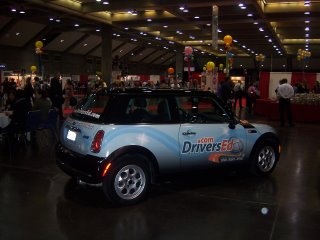
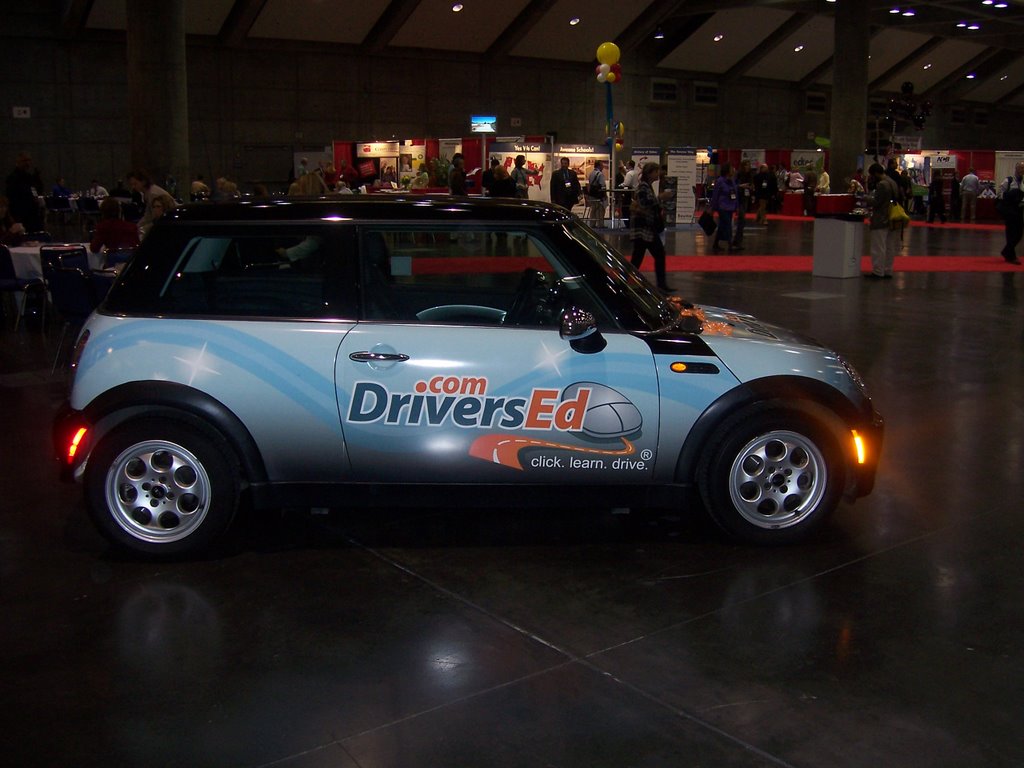
The DriversEd.com Mini Cooper. Guess who got to drive it into the exhibit hall? ME! ME ME ME!

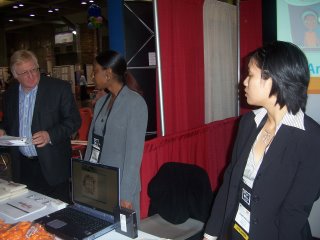
Nerissa and I standing at the booth. As you can see, our mascot Kelly is in the background.

All those orange things on the table are the safety awareness wristbands, which say "I Am Not a Statistic." You can check out our safety campaign at www.NotaStat.com. Turn in a story - get a wristband!

Our beloved CEO Isaak (at left, in case you wondered) dropped in one day to see how we were doing. Please ignore the totally confused expressions on our faces. When this picture was taken, he was saying wonderful things like, "This booth is the coolest ever! And by the way, you guys rock my socks off."

No, I'm lying. He was probably just asking, "How many pages is this packet I'm holding?"

Last week we went to Las Vegas for a School Administrator Symposium managed by EducationEvents.com. We had a grand time (it was Las Vegas - and during March Madness!) and we met some quirky tech and administrative people. I wish I had some pictures for that one but I don't. I visited the Hard Rock Cafe for the first time, which was neat. As a marketer I am easily bought with good service and a little bit of kitsch. It never fails.

'Til next time,

Angela Joy Natividad - The Maven, the Mystery, the Minx behind Marketing

Monday, March 13, 2006

Big News If You Live in Santa Clara County (California)

Starting April 1, 2006 DriversEd.com will be the exclusive traffic school provider for the Santa Clara County Superior Court. DriversEd.com will offer traffic school in classrooms throughout Santa Clara County on a convenient schedule, as well as online traffic school accessible 24 hours a day 7 days a week.

While receiving a ticket is never a happy occasion, at least Santa Clara County residents will know that they now have the most convenient traffic school option available.

If you are cited with a moving violation in Santa Clara County and obtain permission to attend traffic school, you will have 90 days to complete a traffic school course. Starting April 1st, the Santa Clara County Superior Court will only accept Sunset Traffic Academy Certificates of Completion (sent after finishing our in-class course) or Certificates of Completion from the DriversEd.com online traffic school course.

This should make a few people feel safer about driving in Northern California.

Wednesday, March 08, 2006

Driver Education Video Games: A Help to Reduce Collision Statistics?

A game developer in the U.K. recently designed a game that puts users behind-the-wheel and simulates the driving experience. There is nothing new about this form of technology; driving games have been around for years. But the main intent of the developers of the new game, the design agency Splinter and computer simulation specialists Lateral Visions, was to us the game as a driver education tool and to teach teens the risks of reckless driving. The interactive drivers experience the full effect of handling, and potentially crashing, a vehicle.

Although some may scoff at this approach, many have learned to enhance driving skills via games. Professional race car drivers often use computer games to get a feel for a new track. The risk is considerably less while the sensation of driving is similar to what a driver experiences while circling the track.

However, regardless of how prepared a driver may think he or she is after practicing on a computer, real-life is different. The risks are higher and the conditions more varied. Drivers shouldn’t make the mistake of thinking that simulated driving practice is 100% equal to actual road experience.

For more information about driver’s education or to try one version of an online drivers education game, check out DriversEd.com.

Friday, February 03, 2006

DriversEd.com Does Texas!

A couple of us have just returned from Austin, Texas, where we attended a conference and schmoozed like crazy.

Having recently obtained DPS-approval for our parent-taught online course in Texas, we were pretty excited about meeting these people. Most seemed really hyped about developing liaisons with us and checking out the site, so all in all I'd say it was successful.

I've never been to Austin before so my eyes felt big as platters the whole weekend. It's got a great night life and some really nice people. At some point, I wrote down a few funny phrases I heard in casual conversation:

"These are some cute lil' boogers!" (In reference to our I AM NOT A STATISTIC wristbands.)

"Well, kiss a fat baby!" (This is a way of saying, "Isn't that something!" or "I'll be!")

I got exceptionally cool responses when asking, "How are you?":

"I'm as happy as a spotted dog under a wagon!"

"I'm happy as a dead pig in the sunshine!"

Whole 'nother language down there, man.

Wednesday, January 25, 2006

Teen Teaching Tips

Tips for Teaching Your Teen How to Drive:

1) Safety should always be the main concern. When teaching your child how to drive, emphasize safe driving methods. Both good and bad driving habits develop their foundations at the beginning of a driver’s experience. Therefore, it’s important to start off on the right foot. Start each lesson by going over safe vehicle maintenance and rules needed for the day’s activities. Your teen will then learn by example and make this a part of daily driving practice.

You may also want to consider using some tools that help transform your car into a better training vehicle. The Parent-Teen Behind-the-Wheel Training Guide is specifically designed to help you, the parent, systematically teach your teen to drive safely and confidently with printable lessons that you can bring along when you teach practical skills in the car. This guide also includes a detachable rearview mirror. The mirror allows you to monitor the car's surroundings while driving and observe your child's driving techniques. You also will get our "Caution Student Driver" magnet. This notifies other drivers that a new driver is operating the vehicle.

2) Don’t get frustrated; remain calm. This may sound like an unreasonable request; teaching a nervous teen how to drive may one of the hardest things you will ever have to do. However, the tone of the driving lesson is set the minute you step into the car, perhaps even before. Let your teen learn at his or her own pace and take a deep breath if you find yourself becoming frustrated. The less stress your student experiences, the more space he or she will have to learn.Your teen will appreciate it and the lesson will progress more smoothly.

3) Go in with a gameplan. The more planning, the better. It may also be a good idea to practice driving to specific places your teen may drive to frequently (Movies, church, school). If he or she knows the route, driving will be less stressful.

4) Forget your own bad habits. There have probably been a few times in your own driving experience when you have gone above the speed limit, increased you speed for a yellow light, or forgotten to use your turn signal. Make sure you do not do any of this when your child is observing you. Your teens does not have any room to take short cuts.

5) Leave room for questions. If you have successfully accomplished all of the tips listed above, you teen should feel comfortable asking questions when he or she needs to. Remember to keep and open mind and be specific about your answers. Your teen will appreciate it.

Wednesday, January 18, 2006

Get New Desktop - Support the Cause

New "I Am Not A Statistic" desktops are available here:
http://www.deviantart.com/deviation/27836886/
http://www.deviantart.com/deviation/27858776/
http://www.deviantart.com/deviation/27858866/
http://www.deviantart.com/deviation/27858993/
http://www.deviantart.com/deviation/27859061/

Download them and support the campaign against drunk driving.

Currently representing on MySpace

If you haven't talked to our new spokeseperson Kelly yet, you can now meet her on MySpace.

She's pretty dang cute isn't she? Please add her if you have a profile.

Updated by Stephanie - Cooler than James Frey

Monday, January 16, 2006

Winter Driving Tips from the NHSTA

1. Get your car serviced as soon as possible to make sure that everything is in proper working order.
2. Check your battery.
3. Check your cooling system. Any car has the potential to overheat even in cold weather.
4. Fill the washer reservoir.
5. Check your windshield wipers and defrosters. They have to work overtime when conditions are icy.
6. Inspect your tires.
7. Know your car. Be able to handle it if you hit black ice or face another hazardous condition.
8. Plan your travel and route. Planning makes you better able to focus on driving.
9. Stock your vehicle.
10. Learn what to do in a winter emergency.

Consult the National Highway Traffic Safety Administration for more details.

Teen Driving News: L.A. County

In 2002, the Los Angeles County Sheriff’s Department took a drastic step in attempting to reduce the amount of teen driving related fatalities. By enacting the STTOP program (Sheriff’s Teen Traffic Offender Program), L.A. has taken a step forward in reducing reckless teen driving by intervening when new drivers exhibit poor judgment or dangerous driving habits on the road.

Ideally, here’s how it works:
- A citizen spots a teen driving dangerously and dials a special 877 number to report the behavior. The caller should try to note a license number and vehicle or driver description.
- A law enforcement officer will run the plate number and visit the driver’s home to speak with the parents.
- Parents also take responsibility and suspend driving privileges until the teen driver once again proves responsibility.

The idea itself may seem rather simple and quaint, like something straight out of Leave It to Beaver. However, law enforcement officials claim that the program has been successful so far. More community involvement is just what STTOP needs to make it flourish.

If you want to report a dangerous teen driver, call the programs toll-free number 1 (877) 310-STOP (7867).

Friday, January 13, 2006

Car Free Days in Northern California

There can be no doubt that high gas prices, traffic jams, and bad-air days all cause increasing frustration for drivers. Many of these problems also cost city governments quite a bit of money. However, there is a simple solution: don’t drive. This may sound ridiculous, but know that some Northern California cities are trying new methods of reducing some of these problems.

On September 22, 2004, the city of Oakland participated in International Car Free Day. This awareness event has its origins in Europe and aims to have drivers spend one day without using a car and to watch what happens during that day. Hopefully, during the process residents will learn from the event and explore transportation alternatives. The neighboring city of Berkeley also participated in the day’s events. The event was considered a success and Oakland plans to continue its effort in 2006.

Thursday, January 12, 2006

Teen Driving in Las Vegas

Recently, laws regarding teen driving in Las Vegas were updated. These regulations reflect the Nevada Legislature’s concern about the high rate of vehicle accidents and driving related fatalities among new drivers. In 1999, one fifth of all fatal driving accidents in Nevada involved teen drivers. Motor vehicle crashes are also the leading cause of death for 15- to 20-year-olds in America.

Las Vegas teens are subject to new curfew laws. Drivers under the age of 18 may not drive between the hours of 10 p.m. and 5 a.m. unless traveling to or from a scheduled event (such as a planned event for work or a school). Law enforcement officers may ask drivers to show proof of the scheduled event. Although this law applies to drivers statewide, there are also local laws on the book that teens should be aware of. Las Vegas minors currently have a curfew of 9 p.m. (unless accompanied by an adult) on the Las Vegas Strip and Downtown. In other areas of Las Vegas, the minor curfew is 10 p.m. Sunday through Thursday and midnight on Friday and Saturday.

Another new law of concern to Las Vegas teens relates to the experience log that new drivers must keep during the training process. Drivers under the age of 18 who apply for a full license must submit a written log of dates and time conducted of their behind-the-wheel experience. Most Nevada teens are also required to a Certificate of Completion of drivers education. Teens can earn this by enrolling in and completing a drivers education course such as the one found at DriversEd.com.

Wednesday, January 11, 2006

Fort Collins, Colorado Fights Against Teen Drunk Driving

Many Ft. Collins students have benefited from a DriversEd.com course. However, these students still need community support to keep them on track:

Teen Drunk Driving in Fort Collins

According to the Colorado Department of Transportation's Safety and Traffic Branch and the National Highway Traffic Safety Administration, in 1998 nearly 1000 young people aged 14 to 20 in Fort Collins were cited for possession of alcohol and 23 young drivers were charged with driving under the influence. This is a significant number considering the jurisdiction is comprised of fewer than 24,000 teenaged residents.

Because of this, an organization was formed to combat teenage drinking and driving. The goal of team Fort Collins is to reduce the problem by 10 percent through a combination of retailer training (how to prevent underage sales), improved false ID scanning, recruiting of youths to participate in the process, and development of SADD (Students Against Dangerous Decisions) chapters in the four local high schools. Thus far, studies have shown that the program has worked at reducing underage drinking and DUIs significantly.

What can you do to help? The first step is always acknowledgement of the problem. Please consider joining DriversEd.com in the campaign to increase awareness about the problem of teen drinking and driving. Please visit our "I Am Not a Statistic" section for more information.

Tuesday, January 10, 2006

Save on gas!

How to Save Fuel

Gas prices are going up and various organizations around the US have started publishing tips about saving money on fuel. The American Petroleum Institute provides the following recommendations:

1. Keep your vehicle’s engine in good condition. A well-tuned engine allows you to travel one mile farther per gallon of fuel.
2. Maintain proper air pressure in your tires. Here, the amount of fuel savings is also about one extra mile per gallon.
3. The faster you travel, the greater your fuel consumption is. (You lose approximately two miles per gallon every time you raise your speed by ten miles/hour).
4. Try to speed up gradually after stopping for a traffic light.
5. Try to drive smoothly. Stopping, accelerating, or decreasing your speed leads to the loss of two miles per gallon of fuel.
6. Do not allow your engine to idle. Turn the ignition off whenever possible.
7. Use the air-conditioner sparingly as it requires a large amount of power.

The Federal Trade Commission recommends the following:

1. Observe speed limits.
2. Avoid aggressive driving.
Plan your trips. One long trip is better than a few short ones.
3. Do not overload the vehicle. A 200 pound weight increases fuel consumption by 2%.
4. Avoid placing things on top of your car. This can reduce the fuel economy by 5%.
5. Change oil and oil filters frequently.
6. Read your car manual and use the type of gas recommended by the manufacturer. Higher octane gas does not increase fuel efficiency and may not have any positive influence on the car engine.
7. Do not buy any devices from manufacturers who promise dramatic fuel economy. Research shows that in most cases, such devices are useless and sometimes even harmful.